There are moments in a courtroom that feel final.
The gavel comes down. The verdict is read aloud. And just like that, a person’s life changes direction in ways that cannot easily be undone.
For Carter Halston, that moment arrived on an ordinary Thursday morning.
When the Gavel Falls
Judge Lenora Kline had been on the bench for over two decades.
She had seen fear, grief, relief, and fury pass through her courtroom. She had handed down difficult decisions without flinching, because that was what the role required of her.
When she read the verdict that morning, her voice was calm and even.
The room absorbed the weight of her words in near silence.
The prosecutor closed his file. The defense attorney sat back in his chair. The bailiff moved into position without being asked.
Ezoic
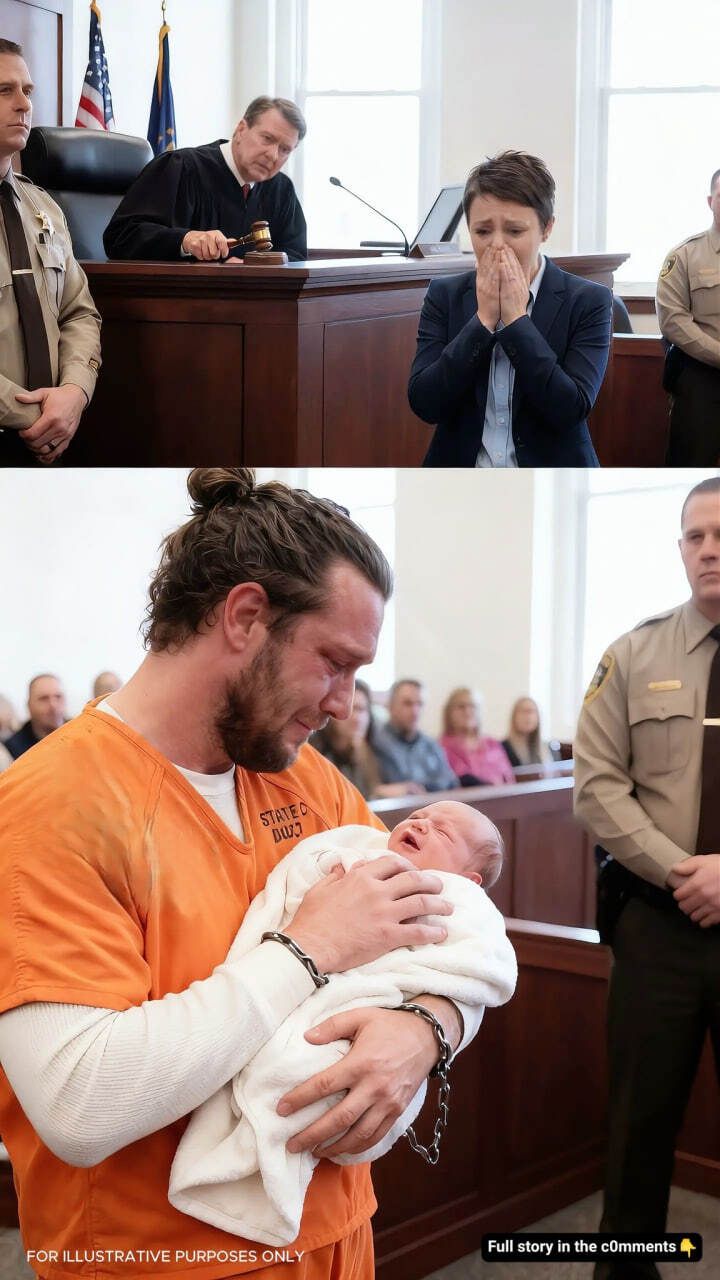
And Carter Halston — a broad-shouldered man in his early thirties, wearing a standard-issue orange uniform — simply stood there.
His wrists were cuffed. His shoulders were tense. But his eyes, remarkably, were clear.
One Request Before Everything Changed
Most people in that situation say nothing after the verdict.
They are ushered out, and the legal process moves forward without fanfare. But Carter did not stay quiet.
He looked at the judge and spoke carefully, his voice low but steady.
“Your Honor,” he said, “I understand the verdict. I’m not asking you to change anything.”
He paused for just a moment.
“My son was born last week. I haven’t held him. Not even once. I just want one minute with him.”
Ezoic
A few people in the gallery shifted uncomfortably. It was an unusual request — the kind that doesn’t appear in any legal handbook.
Judge Kline studied him for a long moment before responding.
A Decision Rooted in Humanity
The judge did not say yes immediately.
She turned to the bailiff and exchanged a quiet word. She considered the security requirements, the protocol, and the circumstances.
Ezoic
Then she looked back at Carter.
“If the child is present,” she said, “and proper supervision is in place, I will allow one minute.”
It was not a legal concession. It was not weakness.
It was simply a recognition that, underneath every case, there are real human lives involved.
The Woman Who Walked Through the Side Door
A few moments passed.
Then the side door of the courtroom opened, and a young woman stepped inside, holding a small bundle wrapped in a soft white blanket.
Her name was Kira Maren.
She had been present throughout the trial — always seated in the same spot, always watching, always quiet. People in the courtroom recognized her immediately.
But today she looked different.
She walked slowly, almost hesitantly, as if each step forward cost her something. Her face carried an expression that went beyond exhaustion. It was the look of someone carrying a truth they had not yet been allowed to speak.
Ezoic
The First Time a Father Holds His Son
The bailiff removed Carter’s handcuffs.
He stood still for a moment before reaching out, as though he needed to prepare himself for what was about to happen.
His hands — large, calloused, trembling slightly — extended toward the baby. Kira looked at him for one long second, then gently placed the newborn into his arms.
The entire room went quiet.
Not politely quiet. Genuinely still — the kind of silence that happens when something real is unfolding in front of people who spend most of their time watching rehearsed moments.
Ezoic
Carter looked down at his son’s face.
And something shifted in his expression — something that no legal proceeding, no courtroom procedure, and no prepared statement could have produced.
“Hey, little man,” he whispered. “I’m sorry I wasn’t there the moment you showed up.”
His voice cracked at the end of the sentence, but he held himself together.
When Something Small Becomes Something Important
For the first few seconds, the baby was calm.
Then, without warning, the infant stiffened slightly in Carter’s arms. His tiny face scrunched. His breathing changed.
And then he cried — loudly, clearly, in a way that cut straight through the quiet of the room.
Ezoic
Carter instinctively adjusted his hold, shifting the baby gently and murmuring soft words.
“Hey, hey… I’ve got you. I’ve got you.”
But as he adjusted the blanket to soothe the child, his hands went still.
He had seen something.
A Birthmark That Stopped Everything
Just below the baby’s collarbone, barely visible above the edge of the blanket, was a small birthmark.
It was an uneven triangular shape with a faint curved line running alongside it — a very distinctive mark.
Carter stared at it.
The color left his face.
“That’s not possible,” he said softly, almost to himself.
Judge Kline leaned forward. “Mr. Halston. What is it?”
Carter looked up at her, and his voice was barely above a whisper.
“My son has the exact same birthmark I was born with.”
The Courtroom Stirs
Birthmarks are not evidence. A shared marking between a father and child does not overturn a legal verdict.
Ezoic
Everyone in that room understood that.
But Judge Kline also understood something else: the prosecution had built part of their case around a specific timeline. And that timeline had just been called into question in a way that could not be easily ignored.
She raised her hand to quiet the murmuring that had begun to spread through the gallery.
“This changes nothing formally,” she said. “But it raises a question that deserves a proper answer.”
The Defense Sees an Opening
Defense attorney Avery Pike rose to his feet without hesitation.
He had been in this profession long enough to recognize when something genuinely significant had just entered the room.
“Your Honor,” he said, his voice measured but firm, “the prosecution’s case rested in part on the argument that the pregnancy had concluded before the timeline in question. If this child is biologically Mr. Halston’s son, that timeline is incorrect.”
Ezoic
Prosecutor Rusk pushed back immediately.
“Speculation,” he said. “This is pure speculation.”
Judge Kline looked at him evenly.
“Speculation is exactly what investigations are designed to address,” she replied. “And that is precisely what I intend to authorize.”
She turned to Kira Maren.
The Woman Who Had Been Waiting to Speak
“State your name for the record,” the judge said.
“Kira Maren.”
“And your relationship to this child?”
Kira was quiet for a moment. When she finally spoke, it was with the careful, measured tone of someone who had been holding back words for a long time.
“There is more to this story,” she said. “More than what was presented during the trial.”
Judge Kline did not react with drama. She simply nodded.
“You will be given the opportunity to provide a full formal statement,” she said. “But answer me this directly: is there reason to question the facts as they were presented in this case?”
Ezoic
Kira met her eyes.
“Yes,” she said. “There is.”
What Happens Next Is Not Like the Movie,
In films, this is the moment where everything turns around instantly.
The judge raises her hand, declares the verdict suspended, and the wronged man walks out into the sunlight while triumphant music plays.
Real life does not work that way.
Judge Kline did not overturn the sentence that afternoon. She did not declare Carter innocent on the spot. She did what the legal system, at its best, is designed to do.
“The court will proceed with a post-verdict review,” she announced. “I am ordering the immediate preservation of all medical records and communications relevant to this case. I am also authorizing expedited paternity and DNA testing.”
Ezoic
It was not a victory. It was not freedom…