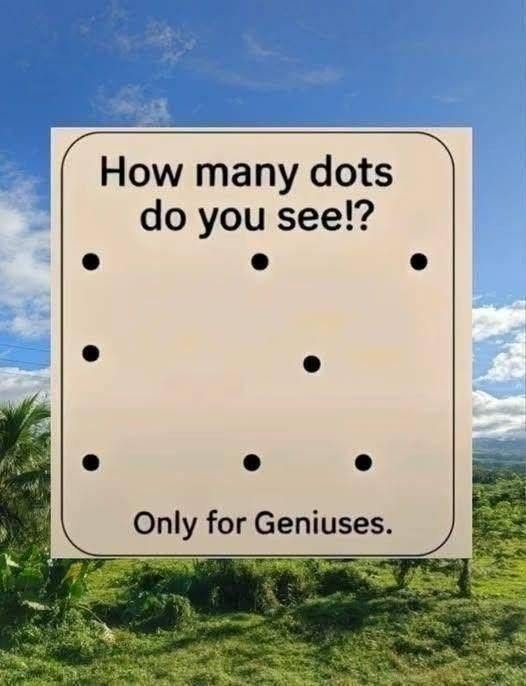
5. Screen Quality and Brightness
Believe it or not, device differences matter.
A dot that is visible on a high-contrast screen might disappear on:
Visual Art & Design
Lower brightness phones
Older monitors
Screens with poor color calibrationDesign
So two people can genuinely see different numbers simply due to hardware.
Design
The Brain Behind the Illusion
The real magic is not in the image—it is in the brain interpreting it.
Your visual system performs three major tasks instantly:
Detect edges and contrast
Group similar objects
Simplify complex patterns
This last step is crucial. The brain prefers efficiency over accuracy. It tries to simplify what it sees into meaningful patterns, even if that means ignoring small details.
Anatomy
To continue reading, click Next
So in a dot puzzle, your brain might:
Anatomy
Group dots into clusters
Ignore faint elements
Fill in missing visual information
This is helpful in real life (like recognizing faces quickly), but it creates errors in artificial puzzles.
So… How Many Dots Are There Really?
Here is the important truth: there is often no single universally agreed answer.
In many viral versions of this puzzle:
Discover more
How-To, DIY & Expert Content
Educational Resources
Crafts
The “official” count depends on how the creator defines a dot
Some include faint or partial dots
Puzzles & Brainteasers
Some exclude overlapping or ambiguous points
So you may see answers like:
16 dots (strict interpretation)
18–20 dots (moderate interpretation)
22+ dots (inclusive interpretation)
The disagreement is not random—it comes from definition boundaries.
If a dot is:
Partially visible → do you count it?
Reference
Overlapping another dot → is it one or two?
Faded into the background → does it qualify?
Different people apply different rules unconsciously.
The Psychology of “Being Right”
One of the most interesting parts of this trend is not the image itself—but how people react to it.
When someone sees a different number than their friends, they often assume:
“I must be right”
Anatomy
“They didn’t look carefully enough”
This triggers a subtle competitiveness. The puzzle becomes less about perception and more about validation.
This is a known effect in cognitive psychology: when uncertainty is high, people tend to defend their perception as truth rather than accept ambiguity.
Why These Images Go Viral So Easily
Dot-counting puzzles spread quickly online for several reasons:
1. Instant Engagement
No instructions needed. You just look and respond.
Discover more
How-To, DIY & Expert Content
Vision Care
Puzzles
2. Social Comparison
People naturally compare answers with others.
Puzzles & Brainteasers
3. Easy Sharing
It takes seconds to post: “How many do you see?”
4. Conflict of Answers
Disagreement fuels comments and debate.
5. Perceived Intelligence Test
Many users treat it like a quick IQ or vision challenge.
This combination makes it perfect viral content.
The Science of Visual Sharpness Tests
While these images are often presented as “eye sharpness tests,” they are not actual medical vision assessments.
Real visual acuity tests measure:
Psychology
Ability to distinguish letters or symbols at distance
Contrast sensitivity under controlled lighting
Field of vision accuracy
Professional tests are standardized, unlike viral illusions.
Discover more
Photo & Image Sharing
Accident
Vehicular Accidents
However, dot puzzles do reveal something interesting: how your brain processes ambiguous visual input.
Common Mistakes People Make When Counting Dots
If you’ve tried one of these puzzles, you’ve probably experienced at least one of these errors:
1. Double Counting
Eyes return to the same area and recount a dot.
Educational Resources
2. Skipping Rows
The brain assumes a pattern is complete and stops checking carefully.
3. Over-grouping
Multiple dots are perceived as one shape.
4. Tunnel Vision
Focusing on the center and ignoring edges.
5. Assumption Errors
Assuming symmetry means equal distribution of dots when it may not.
These mistakes are normal and happen automatically.
How to Improve Accuracy in Dot Puzzles
If you want to get closer to the “true” count, here are practical techniques:
Online Image Galleries
1. Use a Systematic Grid Method
Scan row by row instead of freely looking around.
Discover more
Astrology & Divination
child’s
Motor Vehicle Accidents
2. Zoom In
Increasing image size helps separate crowded dots.
3. Change Brightness
Adjusting screen contrast can reveal faint elements.
4. Mark as You Count
Physically or mentally marking sections reduces repetition errors.
5. Slow Down
Speed increases mistakes in perception-based tasks.
What These Puzzles Actually Measure
Despite being called “eye sharpness tests,” they measure a mix of:
Neuroscience
Attention control
Pattern recognition
Visual discrimination
Cognitive interpretation speed
They are more about brain processing than eyesight alone. Neuroscience
Anatomy
This is why two people with perfect vision can still get different answers.
The Role of Expectations
Expectation strongly shapes perception.
If someone tells you:
“There are 16 dots” → you may subconsciously find 16
“There are hidden dots” → you may overcount
This is known as top-down processing, where the brain uses prior information to interpret sensory input.
It shows that seeing is not purely objective—it is influenced by belief.
Neuroscience
Why There Is No “One Correct Answer” in Many Cases
Many viral puzzles are not designed with a strict answer key. Instead, they are built to:
Encourage discussion
Increase engagement
Highlight perceptual differences
In carefully designed scientific experiments, stimuli are controlled to avoid ambiguity. Viral content, however, often embraces ambiguity because it generates interaction. Science
So the “correct answer” depends on:
Discover more
Biological Sciences
Online Image Galleries
science
Image resolution
Psychology
Interpretation rules
Viewer perception
A Deeper Look: What This Says About Human Perception
These simple dot puzzles reveal something profound:
Your brain is not a passive receiver of reality. It is an active interpreter.
What you “see” is constructed from:
Sensory input Psychology
Memory
Expectations
Attention
Environmental conditions
Science
Two people looking at the same image are not just seeing differently—they are constructing reality differently in small but measurable ways.
That is the real reason these puzzles feel so engaging. They expose the hidden subjectivity in something we assume is objective: vision.
Anatomy
Conclusion: It Was Never Just About the Dots
The question “How many dots do you see?” seems simple, but it opens the door to a surprisingly deep exploration of human perception.Online Image Galleries
What begins as a viral challenge quickly becomes a lesson in how the brain works:
It simplifies what it sees
It fills in missing information
It prioritizes patterns over precision
It is influenced by expectation and attention
So when people argue over whether there are 16, 18, or 22 dots, they are not just counting—they are experiencing different interpretations of reality.
Dictionaries & Encyclopedias
And that is what makes these illusions so powerful.
The next time you see one of these images, the interesting question is not just “How many dots are theOnline Image Galleries