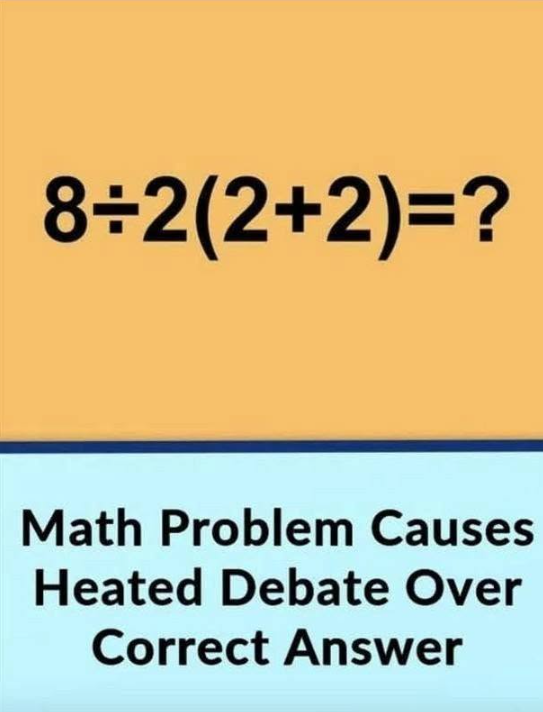
The Math Problem That Divided the Internet: Why One Simple Equation Sparked a Global Debate
Every few months, the internet finds a new obsession.
Sometimes it’s a celebrity controversy. Sometimes it’s a strange optical illusion. And sometimes — surprisingly — it’s math.
Not advanced calculus.
Not quantum equations.
Just a simple arithmetic problem that looks easy enough for a middle school student.
Yet somehow, millions of people end up arguing passionately in comment sections, creating YouTube breakdowns, posting angry TikTok reactions, and insisting everyone else is wrong.
One of the most famous examples looked like this:
8 ÷ 2(2 + 2)
At first glance, it seems straightforward.
But when this equation began circulating online, it created complete chaos.
Some people confidently claimed the answer was 1.
Others insisted it was 16.
Friendships were jokingly “ended.” Teachers entered the debate. Engineers argued with programmers. Entire Reddit threads exploded into mathematical warfare.
How could one tiny equation split the internet in half?
The answer reveals something fascinating not only about mathematics, but also about how humans interpret information, follow rules, and defend being “right.”
The Equation That Started the Argument
Let’s look at the problem again:
8 ÷ 2(2 + 2)
Most people begin by solving the parentheses first.
Inside the parentheses:
2 + 2 = 4
So now the equation becomes:
8 ÷ 2(4)
And this is where the internet loses its mind.
One group interprets the equation as:
8 ÷ [2(4)]
Which becomes:
8 ÷ 8 = 1
Another group follows the operations from left to right:
8 ÷ 2 × 4
Which becomes:
4 × 4 = 16
So which answer is correct?
Technically, under modern mathematical conventions, 16 is generally considered correct.
But the fact that millions of intelligent people arrived at different answers exposes a deeper issue:
The equation itself is poorly written.
Why People Get Different Answers
Most of us learned the order of operations in school through acronyms like:
PEMDAS
BODMAS
BIDMAS
Depending on where you grew up.
These stand for:
Parentheses/Brackets
Exponents/Orders
Multiplication and Division
Addition and Subtraction
But here’s the critical detail many people forget:
Multiplication and division are equal in priority.
You do them from left to right.
The same applies to addition and subtraction.
That means after solving the parentheses, the equation becomes:
8 ÷ 2 × 4
Now go left to right:
8 ÷ 2 = 4
4 × 4 = 16
Simple.
Except… not everyone was taught to interpret implicit multiplication the same way.
And that’s where things become messy.
The Hidden Problem: Implicit Multiplication
The expression 2(4) is an example of implicit multiplication.
Instead of writing:
2 × 4
the multiplication symbol is omitted.
In higher mathematics, implicit multiplication is often treated more strongly than explicit multiplication or division because it visually groups terms together.
For example:
1 ÷ 2x
can look ambiguous.
Does it mean:
(1 ÷ 2) × x
or
1 ÷ (2x)
Different textbooks, calculators, and software systems sometimes interpret these differently.
That’s why mathematicians generally avoid writing equations this way in formal work.
The internet equation became famous precisely because it sits in this ambiguous gray area between strict arithmetic rules and visual interpretation.
Why Calculators Sometimes Disagree
One reason these math debates become so heated is that people rush to calculators expecting a definitive answer.
But surprisingly, calculators don’t always agree.
Some calculators output:
1
Others output:
16
Why?
Because calculator software is programmed differently.
Some systems prioritize immediate left-to-right evaluation.
Others interpret implicit multiplication more tightly.
Computer algebra systems often use entirely separate parsing rules.
This shocks many people because we assume mathematics is always perfectly objective.
The truth is:
Math itself is objective.
Notation is not always objective.
Humans invented notation to communicate math, and sometimes that communication is imperfect.
The Internet Loves Being Right
If the issue were purely mathematical, these debates would disappear quickly.
But they don’t.
Because internet math problems are rarely just about math…