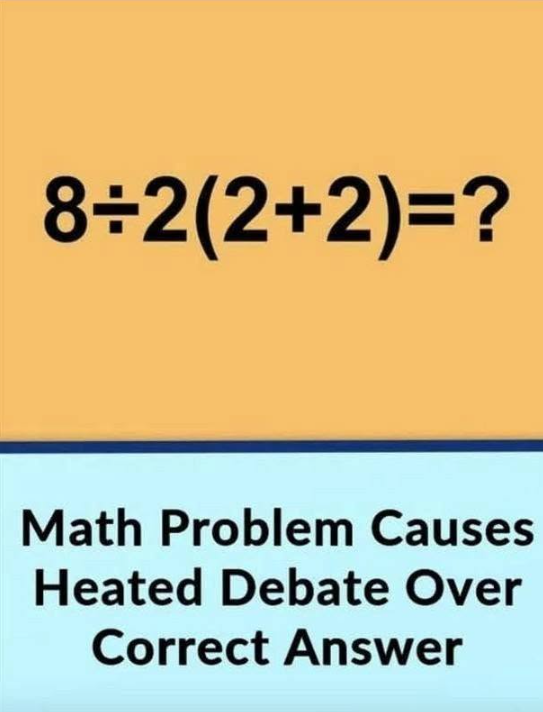
They become competitions.
People attach intelligence and identity to their answers.
Comment sections quickly fill with statements like:
“Anyone who says 1 failed school.”
“Only people who understand real math get 16.”
“Engineers know the answer is 1.”
“This proves the education system is broken.”
The equation transforms into a social battle.
And social battles online escalate fast.
Psychologists call this confirmation bias — our tendency to defend conclusions we already believe are correct.
Once someone publicly commits to an answer, changing their mind feels emotionally uncomfortable.
Especially online.
Why Ambiguous Problems Go Viral
The internet thrives on engagement.
And confusion creates engagement better than clarity.
A perfectly written equation with one obvious answer is boring.
An ambiguous equation that splits audiences into tribes?
That’s algorithm gold.
People comment.
Argue.
Share.
Tag friends.
Create response videos.
Rage boosts visibility.
This is why similar math puzzles repeatedly go viral.
Examples include:
6 ÷ 2(1 + 2)
9 – 3 ÷ 1/3 + 1
The infamous “cow math” riddles
Viral geometry puzzles
Fake IQ tests
Many are intentionally written to maximize ambiguity.
Not to educate people.
To provoke them.
And it works brilliantly.
The Real Lesson Isn’t Arithmetic
Ironically, the most important lesson from these debates has little to do with arithmetic.
It’s about communication.
Professional mathematicians, scientists, and engineers avoid ambiguity constantly.
That’s why formal mathematical writing uses clear notation like:
8
2
(
2
+
2
)
2(2+2)8
or
(
8
2
)
(
2
+
2
)
(28)(2+2)
Clear formatting eliminates confusion.
In professional environments, ambiguity can cause major problems.
Imagine unclear equations in:
engineering blueprints
medical calculations
aviation software
financial systems
Precision matters.
The internet equation became famous because it demonstrates what happens when precision disappears.
Even Experts Sometimes Disagree
One fascinating aspect of these viral debates is that even highly educated people occasionally disagree.
Not because they can’t do arithmetic.
But because they interpret notation differently based on training and context.
Older mathematical styles sometimes implied stronger grouping with juxtaposition multiplication.
Modern educational standards often emphasize strict PEMDAS left-to-right processing.
Different countries teach notation differently too.
So when two intelligent people argue over the same equation, they may actually be using slightly different conventions.
That doesn’t mean math is broken.
It means language and symbols evolve over time.
Social Media Changed How We Learn Math
Before the internet, math learning happened mostly in classrooms and textbooks.
Today, millions of people encounter math through:
TikTok videos
memes
YouTube shorts
Twitter debates
Facebook posts
This changes how mathematical ideas spread.
Short-form content rewards speed and certainty, not nuance.
Creators often present controversial equations dramatically because outrage generates clicks.
Titles like:
“Only Geniuses Can Solve This!”
“90% of People Get This Wrong!”
“This Equation Broke the Internet!”
make viewers emotionally invested immediately.
But real mathematics is often slower and more careful than viral content allows.
Why People Secretly Love These Debates
Despite the arguments, many people genuinely enjoy internet math battles.
Why?
Because they create a rare kind of intellectual participation.
Unlike politics or celebrity gossip, math feels solvable.
Everyone can attempt the puzzle themselves.
There’s satisfaction in working through the steps and arriving at an answer.
Even disagreement becomes entertaining because people feel they are defending logic itself.
These problems also trigger nostalgia.
They remind adults of school classrooms, homework struggles, and mental competition.
And when someone solves a “viral impossible equation,” they experience a quick burst of accomplishment.
The internet understands this psychology extremely well.
The Broader Internet Phenomenon
The “dividing internet” equation is part of a larger online pattern.
The web loves content that produces binary camps:
blue dress vs gold dress
pineapple on pizza
Android vs iPhone
Marvel vs DC
introverts vs extroverts
Math problems fit perfectly into this structure because they appear objective while still allowing disagreement through ambiguity.
That combination is irresistible online.
People don’t just want answers.
They want validation.
So What’s the Correct Answer?
For the famous equation:
8 ÷ 2(2 + 2)
Most modern interpretations using standard order-of-operations rules produce:
16
Because:
parentheses first
multiplication/division left to right
However, many mathematicians would argue the equation is badly written and should never appear in professional mathematical communication without clearer notation.
In other words:
The biggest mistake wasn’t getting the “wrong” answer.
It was writing the equation ambiguously in the first place.
What This Says About Human Nature
The internet’s obsession with viral math problems reveals something surprisingly human.
People crave certainty.
We want rules to feel stable and universal.
So when a tiny equation suddenly produces multiple interpretations, it creates discomfort.
That discomfort turns into debate.
Debate turns into tribal identity.
And identity fuels endless online engagement.
But there’s also something positive hidden inside these moments.
Millions of people who normally never think about mathematics suddenly become curious about logic, notation, and reasoning.
Teachers discuss order of operations again.
Students revisit forgotten concepts.
Families argue playfully at dinner tables.
Math becomes social.
And perhaps that’s why these equations continue spreading year after year.
Not because people love conflict.
But because deep down, humans enjoy solving puzzles together — even when we disagree about the solution.
Final Thoughts
The “math problem that divided the internet” was never really just about arithmetic.
It became a cultural phenomenon because it combined ambiguity, ego, logic, competition, and social media psychology into one tiny expression.
A few symbols on a screen managed to trigger worldwide arguments involving students, teachers, engineers, programmers, and casual internet users alike.
And in a strange way, that’s kind of beautiful.
Because for a brief moment, millions of people stopped scrolling passively and actually thought deeply about something.